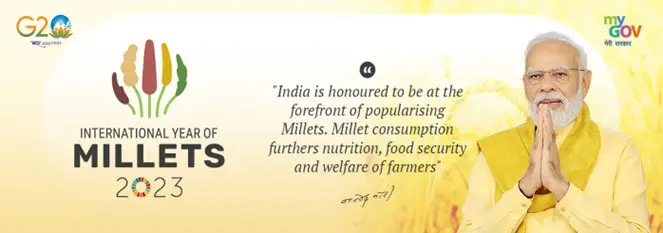
International Year of Millets 2023
On 1st February 2022: “2023 has been announced as the International Year of Millets by Govt. of India.Millets are small-grained, annual, warm-weather cereals belonging to the grass family. Jowar (Sorghum), Bajra (Pearl Millet) and Ragi (Finger millet) are the important millets cultivated in India. Small Millets such as Proso (Cheena), Kodo (Kodra, Arikelu), Fox tail (Kangni/Korra), Barnyard (Varai, Sawa), Little millet (Kutki) are also grown in our country. When it comes to the global scenario of millet production, India is the top producer of millets in the world and the fifth-largest exporter of millets globally. As the demand for millets rises quickly, their exports are expanding dramatically. More business opportunities are being created for entrepreneurs as millets’ demand rises. The millet market has a value of over USD 9 billion in 2018 and is expected to grow at a rate of over 4.5% from 2018 to 2025, with a value projection of over USD 12 billion.
Apart from creating business opportunities, Millets also aid in the prevention of numerous non-communicable lifestyle diseases such as diabetes, hypertension, and cardiovascular disease and are considered to be a potential choice or solution to lessen the negative effects of rising malnutrition and to improve the food and nutrition security of the nation. Due to their adaptability to a wide range of temperatures and moisture regimes as well as their low input requirements, millets are resistant to climate change. They are resilient crops with small water and carbon footprints. Millets can withstand droughts and can even survive on 350–400 mm of rain making them an ideal crop for production.
The International Year of Millet provides an excellent chance to:
- Improved millet’s contribution to food security
2. Increase millet output globally
3. Making sure that the processing, transport, storage, and consumption are efficient
4. Sustainable millet production and quality with stakeholder participation
Rajasthan contributes around 42 percent of the country’s total bajra production.
- Improved millet’s contribution to food security